5 Reasons You Should Not Use Conventional Household Cleaning Products & Safer Alternatives
If cleaning is meant to make your home feel better, why does it sometimes feel worse afterward?
When we say conventional household cleaning products, we mean the usual supermarket sprays and multi-purpose cleaners that many people reach for by default. They usually work fast, smell strong, and come in a different bottle for every job. The catch is that speed and scent can come with trade-offs you notice in the air you breathe, on your skin, and in what goes down the drain.
In this blog, we will take a practical look at why conventional cleaners can be a problem and at simple ways to swap most of your routine.
What are conventional cleaning products?
In everyday terms, “conventional” usually means household cleaners with strong synthetic chemistry and heavy fragrance. Not every single product fits this perfectly, but many mainstream formulas lean on a similar toolkit: synthetic surfactants, stronger solvents, bleach or ammonia-style actives, disinfectants, and fragrance and dyes to create that “this must be clean” signal.
Here is how you can recognize conventional cleaning products.
-
The scent feels intense, and it hangs around after you finish.
-
Your hands feel dry or tight after wiping things down.
-
Your eyes sting a bit in small spaces (ensuites are a classic).
-
You find yourself reaching for gloves more often than you want.
Before we get into the reasons, let's consider when stronger disinfectants make sense
Let’s separate two jobs that often get blended together:
-
Cleaning removes dirt, grease, food residue, and grime.
-
Disinfecting targets germs, usually with a product designed for that job and a specific contact time.
Most of the time, what you need at home is good cleaning, not constant disinfecting. For everyday mess in kitchens, bathrooms, and laundry, well-formulated sustainable cleaners can perform similarly to conventional products.
There are moments when a stronger disinfectant can be reasonable, such as stomach bug outbreaks, higher-risk contamination, or situations where you are following specific medical advice. The key is using it targeted, well-ventilated, and only when it fits the job, rather than as your default spray for everything.
For this, we usually suggest using eco-friendly home cleaning products for the bulk of your routine, then keep one clearly labelled disinfectant for rare, high-risk situations, used with ventilation and directions followed.
5 Reasons Why You Should Not Use Conventional Household Cleaning Products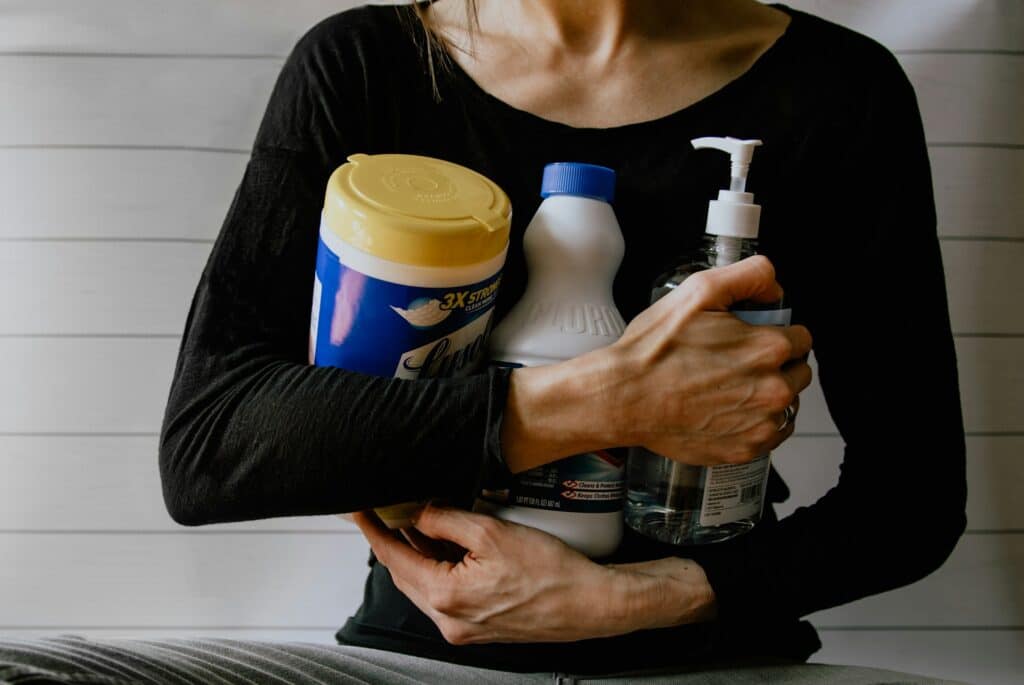
1. They can make your indoor air worse
This is the one people notice first, because it is immediate. A lot of conventional household cleaning supplies release harmful volatile organic compounds (VOCs) and other toxic airborne irritants, especially when you spray them into the air or use them in small rooms with limited airflow.
And here is the sneaky part: the “clean smell” can trick your brain into thinking the job is done. However, a strong smell is not a cleanliness metric. It is simply a product choice.
It gets worse in very normal, very human situations:
-
The lemony mist in a tiny ensuite with the fan that barely works.
-
Wiping the bench while the kettle boils, and the air feels thick for a minute.
-
Spray-and-leave habits when you are rushing out the door, so the product hangs in the room.
If you have ever finished cleaning and thought, why do I feel like I need fresh air now, you are not imagining it. Habits matter as much as the bottle, and choosing low-scent options can reduce the indoor air “spike” without making you clean less.
Read Also: How Cleaning Products Affect Indoor Air Quality
2. They often trigger skin, eye, and sensitivity issues
A lot of people start looking for eco home cleaning products because someone in the house reacts. It might be dry hands after wiping the kitchen down. It might be watery eyes after spraying the bathroom.
We also found that allergies and sensitivities are a common reason customers make the switch.
Fragrance is usually the biggest reason because fragrance-heavy formulas are a top “regret trigger” as scent can linger and feel irritating in small rooms with poor airflow. And honestly, that tracks with real life. The smallest rooms tend to be the places we clean quickly… with the strongest sprays… and the worst ventilation.
If you want a starting point:
-
Choose low-scent or fragrance-free products where you can, especially for the products you use most often.
-
Consider non-aerosol formats (liquids/foams/powders) if sprays set you off.
-
Build a small “core kit” so you are not constantly trialing random bottles.
I have seen people keep a cleaner under the sink for months, untouched, because they know how their hands will feel after using it.
Read Also: How to Choose Non-Toxic Cleaning Products
3. They are rough on waterways, greywater, and septic systems
Every time we mop, scrub the shower, or rinse out a bucket, that water goes somewhere. If we are on septic, or you use recycled/greywater at home, what you pour down the drain can have knock-on effects.
Eco-friendly cleaners often aim for biodegradability, and for septic/greywater setups, it comes down to choosing products that are clearly labelled for those systems. Eco cleaners can be safer for septic and greywater, but the ones specifically labelled septic-safe or greywater-safe are the smart choice for regular use of cleaning products.
So, if your home uses greywater or septic, pick a cleaner that is clearly labelled for your system, then build the rest of your cupboard around it so you are not guessing each time.
4. You end up paying for chemicals that do not help with cleaning
Many conventional cleaning products are built to sell an experience as much as they are built to clean. That often means you pay for extras like heavy fragrance, colour, and “freshness” marketing, things that do not remove grime any better.
And then real life happens.
You clean the kitchen right before dinner, and the scent clashes with the food. You light a candle later, and now the house smells like a weird mix of lemon cleaner + vanilla. You try to use essential oils, but the harmful chemical fragrance bulldozes everything.
Then there is the performance problem people rarely connect back to the bottle: overuse. When a cleaner smells strong, it is easy to assume more product = more clean.
Have you ever cleaned a surface and it still felt sticky after? That often happens when product residue builds up, or when you are using more than the surface actually needs.
The fix tends to be boring (which is good news): use less product, let it sit when needed, and use it with the right tool so you are not scrubbing with brute force.
Read Also: Eco-Friendly Cleaning Mistakes and How to Avoid Them
Reason 5. They create more waste
If you have ever opened the cupboard under the sink and thought, why do we have so many bottles?… yeah. That is the default path with conventional cleaners. You buy one for the glass, one for the bathroom, one for the toilet, one for the floors, then a “backup” because it was on special. Before long, you have a half-used collection of plastic bottles, and none of it feels simple.
The annoying part is not only the waste. It is the clutter. When your regular cleaning products feel messy, cleaning feels messy. You waste time looking for the “right” bottle, or you end up using whatever is closest and hoping it works.
Natural cleaning tends to push you in the opposite direction: fewer core products, smarter packaging, and often concentrated options that last longer.
FAQs
Do eco-friendly cleaners disinfect as well as conventional ones?
Some do, but it depends on the product and how it is used. For everyday cleaning, you usually do not need disinfecting power every time.
What should I avoid if fragrance triggers headaches?
Start by avoiding strong fragrance and choosing low-scent or fragrance-free options where you can. The label-reading approach helps a lot here.
Are eco cleaners safer for greywater and septic systems?
Many eco options are made with biodegradability in mind, and some are labelled greywater/septic-friendly. If your home uses recycled water, choosing products with that in mind is a sensible move.
Do natural cleaners actually work on grease?
Yes, especially for everyday kitchen grease. The trick is using the right product and giving it a moment on the surface, instead of spraying and wiping instantly.
Is “non-toxic” a regulated term?
Not always in the way people assume, which is why the ingredients and clear product claims matter more than big front-label words. A quick checklist makes it easier to shop.
How do I avoid residue and streaks?
Use less product than you think you need, and wipe with a clean cloth. If you still get streaks, a quick second wipe with plain water usually fixes it.
Switch to Non-Toxic Cleaning Products Today
If you have been using conventional cleaners for years, switching can feel like a big change, but it does not have to be. Most people notice the difference when they start small, swap one everyday product, and let the new routine settle in before they add anything else.
And if you are thinking, “Okay, where do I even start?” start from the kitchen. A simple multi-surface cleaner you actually like using, paired with the right cloth or brush, gets you a long way. From there, you can build a small core kit that covers the bathroom and laundry too, without making your routine complicated.
If you want an eco cleaning setup that covers kitchen, bathroom, and laundry without guesswork, take a look at the Eco cleaning product range and choose a few basics that suit your home.
 Free Shipping* on all orders over $99





Leave a Reply
Your email address will not be published. Required fields are marked *